

Escape or unescape a string for JS/JSON string literals instantly in your browser.
Updated
/ 5 - Be the first to rate this tool Thanks for rating!
Verification failed - please try again.
Quick check
Please verify you're not a robot to submit your rating.
Give feedback
Tell us what you think about Escape or unescape a string online.
- Runs entirely in your browser — your text is never sent to a server
- Escape or unescape for JS/JSON string literals
- Free, no account required
How it works
-
1
Paste the text, code, or token you want to encode or decode.
-
2
Conversion happens instantly as you type.
-
3
Review the result, including any decoded structure.
-
4
Copy the result to your clipboard.
Why use this tool
Every dev utility, one place
Format, convert, encode, decode, and generate — no more juggling ten tabs.
100% private, always
Every tool runs in your browser — your code and data are never sent anywhere.
Works on any device
Runs on Windows, Mac, Linux, iOS, and Android — nothing to install.
Instant results
No queues, no build step — results update as you type.
Built to handle real data
Full Unicode support and RFC-compliant parsing, edge cases included.
Free, always
Free to use, with no rate limits, sign-up, or trial period.
Frequently asked questions
It follows standard JSON stringification rules, prepending backslashes to quotes, newlines, and tabs.
Standard JSON only requires double quotes to be escaped, so single quotes usually remain untouched.
No, it purely modifies the inner characters, allowing you to paste it into an existing formatted file.
No, database escaping requires entirely different rules; this tool is strictly for programming strings.
Yes, the unescape function will translate literal \n characters back into real line breaks.
From the blog
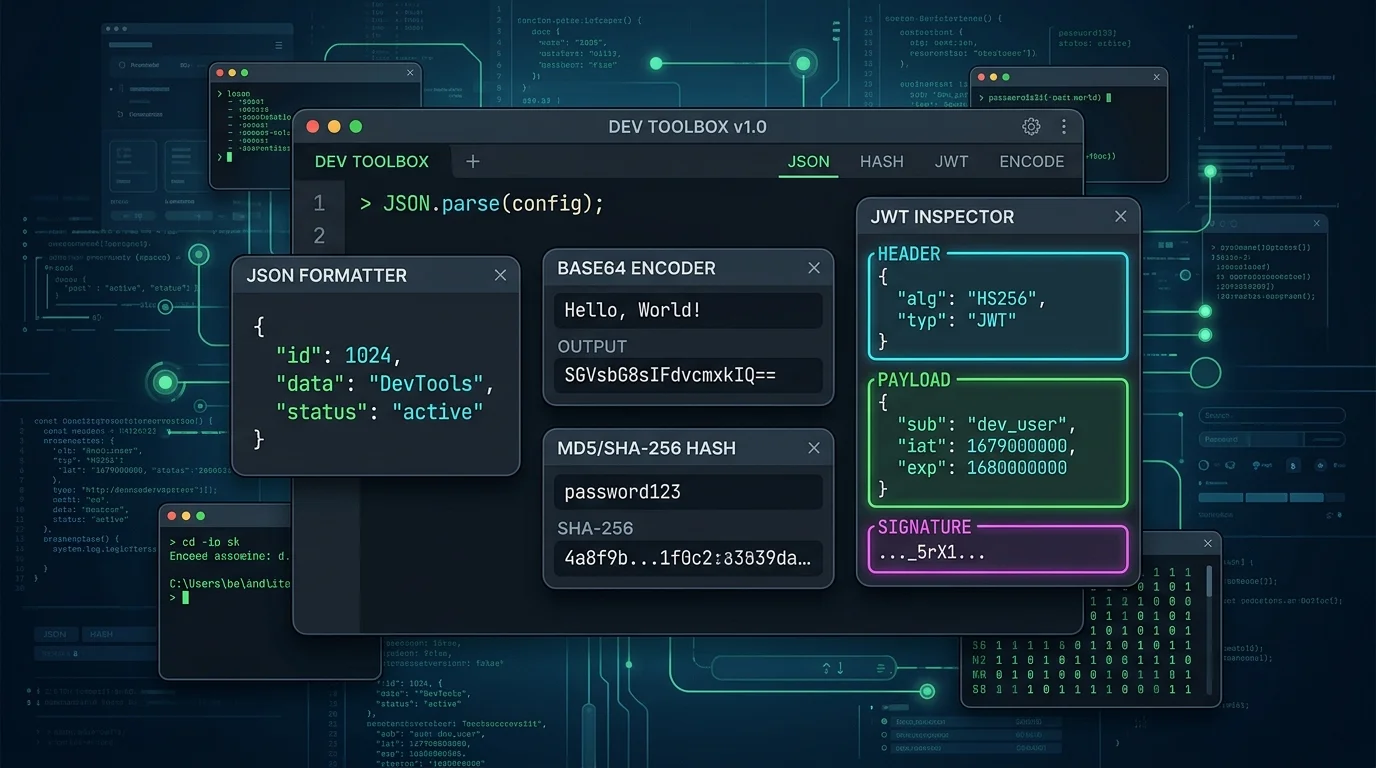
Reading a JWT Without Trusting It: Claims, Expiry, and the Signature Trap
Decoding a JWT takes a second. Verifying one is a different job entirely — and confusing the two is how auth bugs ship. Here is how to read a token safely while you debug.

Mastering Base64: What It Is, How It Works, and When Not to Use It
Base64 is everywhere in modern web development, from data URIs to authentication headers. Here is a deep dive into how it works and common pitfalls to avoid.

Demystifying JSON: How to Troubleshoot Common Parsing Errors
JSON is the backbone of web APIs, but syntax mistakes can halt your code. Here is how to identify and fix missing commas, unescaped strings, and trailing characters.
Related tools
Base64 encode or decode text online
Convert text to and from Base64 instantly in your browser, with full Unicode support.
Encode or decode ROT13 and Caesar cipher text
Shift letters by any amount, including the classic ROT13, instantly in your browser.
Encode or decode HTML entities online
Convert text to and from HTML entities instantly in your browser.
Decode a JWT online
Paste a JSON Web Token to instantly view its decoded header and payload in your browser.
Build and sign a JWT online
Build and HMAC-SHA256-sign a JWT from a header, payload, and secret, instantly in your browser.
Encode or decode a Punycode domain
Convert an internationalized domain name to and from its Punycode (xn--) form, in your browser.
AISummarize a PDF with AI
Get a plain-language summary of any PDF document in seconds.
Optimize and minify SVG files
Shrink SVG files by removing comments, editor metadata, empty groups and extra precision, right in your browser.
Convert text to binary or hex and back
Convert text to binary or hexadecimal UTF-8 bytes and decode them back to text, instantly in your browser.
Compare two texts and see the differences
Paste two blocks of text to see every added and removed line highlighted, instantly in your browser.
Convert a Unix timestamp to a date
Convert a Unix timestamp to a human-readable date, or a date back to a timestamp, in your browser.
Convert TOML to JSON and JSON to TOML
Convert TOML config files to pretty JSON and JSON back to TOML, with tables, arrays of tables and dates. Parse errors show the line number, entirely in your browser.